
Huoliss innovative product
Our tests and analyses, detailed below, have shown that Huoliss is not only a healthy product but also enhances the attractiveness and palatability of food for cats and dogs.
DESCRIPTION
The characteristics of Huoliss are detailed in the table below. This product is specifically designed to enhance the palatability of dry dog food. The Huoliss development and qualification process ensures a standardized product that delivers effective palatability when applied to kibbles. The high performance of the product has been evaluated on various kibble models by expert panels.
SUGGESTED APPLICATIONS
Huoliss is applied by spraying at ambient temperature (20-30 °C) at dosages ranging from 1 % to 4 % on kibbles.
It is advised to apply the liquid palatability enhancer:
After fat is applied
On warm kibbles (> 40 °C) if the fat dosage exceeds 5-6 %
Homogeneously, with effective kibble mixing during and after coating
Palatability of the product will be optimized through high-quality coating.
COMPOSITION
Pork by-products, mineral substances.
CHARACTERISTICS
| Characteristics | Details |
|---|---|
| Product Designation | LIQUID FOR DRY DOG FOOD |
| Usage | DRY |
| Product Category | PREMIUM |
| Destination | DOG |
| Product Type | LIQUID |
| Application | COATING |
ORGANOLEPTIC AND CHEMICAL-PHYSICAL PROPERTIES (*)
| Data | Value | Tolerance | Unit | Method | Comments |
|---|---|---|---|---|---|
| Moisture | 80 | +/- 3% | % | Standard Methodology | |
| Protein | 15 | +/- 2% | % | Standard Methodology | |
| Fat | 2 | +/- 1% | % | Standard Methodology | |
| Ash | 2 | +/- 1% | % | Standard Methodology | |
| pH | 2.9 | +/- 0.2 | Standard Methodology | ||
| Color | Brown | Visual evaluation |
MICROBIOLOGICAL SPECIFICATIONS (*)
| Data | Target | Unit | Method |
|---|---|---|---|
| Enterobacteria | < 300 | CFU/g | Standard Methodology |
| Salmonella | Absence | / 25 g | Standard Methodology |
MINERALS (*)
| Mineral | Value | Unit |
|---|---|---|
| Ca | 0.02 | % |
| K | 0.13 | % |
| Na | 0.17 | % |
| Cl | 0.14 | % |
| Mg | <0.002 | % |
| P | 0.46 | % |
PACKAGING, SHELF-LIFE AND STORAGE
| Packaging | 1 | 2 | 3 |
|---|---|---|---|
| Shelf life (months) | 2 | 6 | 6 |
| Receptacle | Bulk/Tank | Container/IBC | Drum |
| Weight | 1,000 kg | 1,000 kg | 120 kg |
| Temperature min. | 0°C | 0°C | 0°C |
| Temperature max. | 30°C | 30°C | 30°C |
Shelf-life before opening from production date. The product should be stored in a dry room, and away from direct sunlight. After opening: all products should be used within 5 days. To preserve the quality of the product, it is recommended to keep it sealed and away from other products that could impact the flavor. It is advised to clean the storage tanks and the pipe lines between each delivery.
For packaging recycling: please contact your supplier or local collector.
Collagen is a protein found exclusively in animals, particularly in the skin, bones, and connective tissues of birds and fish. It plays a crucial role in maintaining the structural integrity of various tissues and organs throughout the body. There are several ‘types’ of collagen found in different tissues, but they all share a common feature—three polypeptide chains woven into a triple helix structure.
Collagen is classified into types: I, II, and III.
Type I collagen is the most abundant, making up over 90% of the protein in bones. It is the primary component of tendons (connective tissue that attaches muscles to bones) and ligaments (connective tissue that links bones together in joints), providing strength and structure to these tissues.
Type I and III collagen are found in large quantities in the dermis layer of the skin, where they offer structural support and elasticity, helping maintain firmness and moisture retention, as well as protecting against the penetration of toxins and microorganisms.
Type II collagen is the main component of cartilage—a tough, flexible, and semi-rigid tissue located at bone junctions. It provides a smooth surface for joint movement and serves as a cushion to absorb impacts, particularly in weight-bearing joints like hips and elbows.
Collagen is also found in smooth muscle tissue, blood vessels, the digestive tract, heart, gallbladder, kidneys, and bladder, holding cells and tissues together.
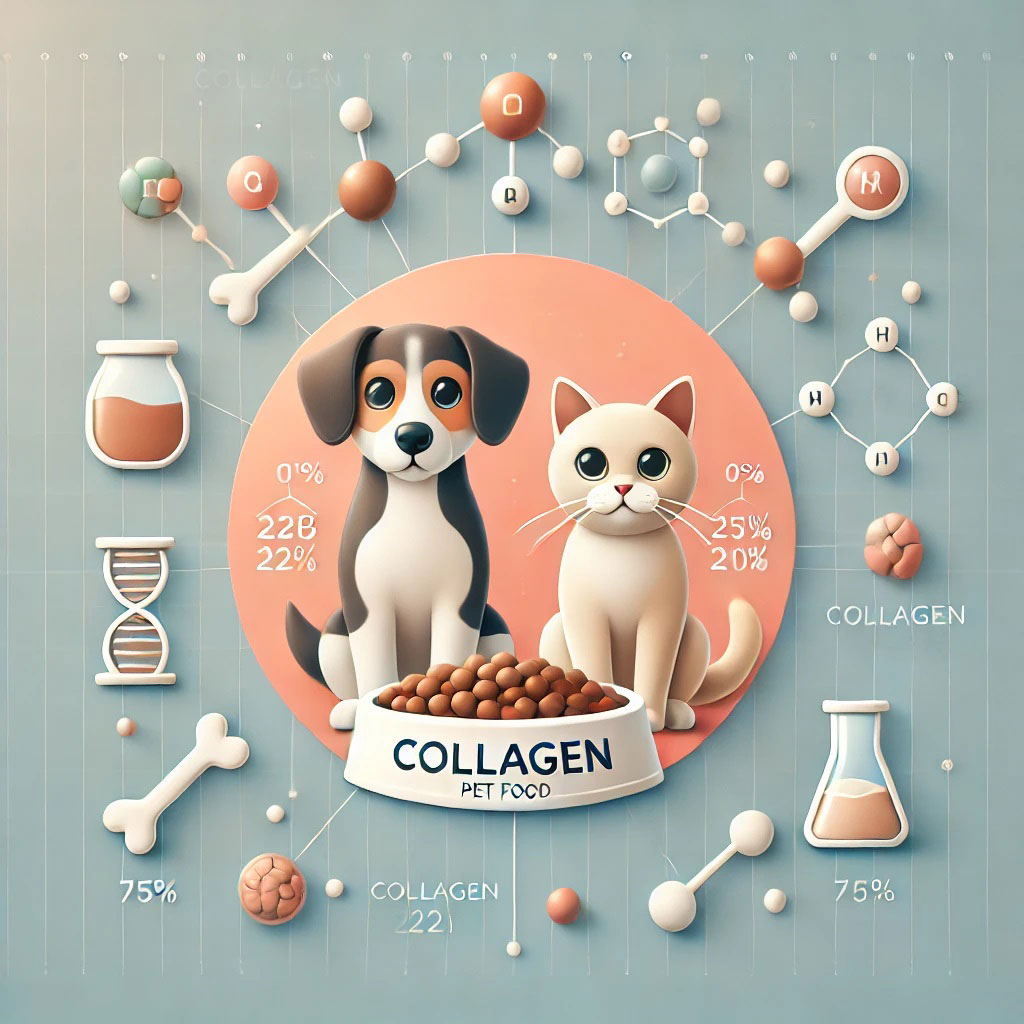
Supports strong, healthy joints in young, active dogs
Support mobility and flexibility in older dogs
Provides the basis for bone materialization
Important for strong, healthy bones at all stages of life
Like all proteins, collagen is made up of amino acids. However, its composition and sequence of amino acids are unique. Collagen is particularly rich in glycine (Gly) and proline (Pro), as well as a proline derivative—hydroxyproline (Hyp). These amino acids are arranged in a specific pattern within each of the three collagen subunits, often following the sequence Gly-Pro-X or Gly-X-Hyp, where X can be any other amino acid residue.
All types of collagen are composed of three polypeptide chains that form a triple helix. Depending on the type of collagen, these chains can be identical or consist of two or more different chains.
Like all proteins, collagen does not last forever—the natural cycle of breakdown and regeneration is continuous. However, this breakdown can be accelerated by daily wear and aging. As we age, collagen production slows, and the structure of connective tissues weakens. Consequently, the skin becomes thinner and more prone to damage, tendons and ligaments lose elasticity, and joints become stiffer and/or more painful to move.
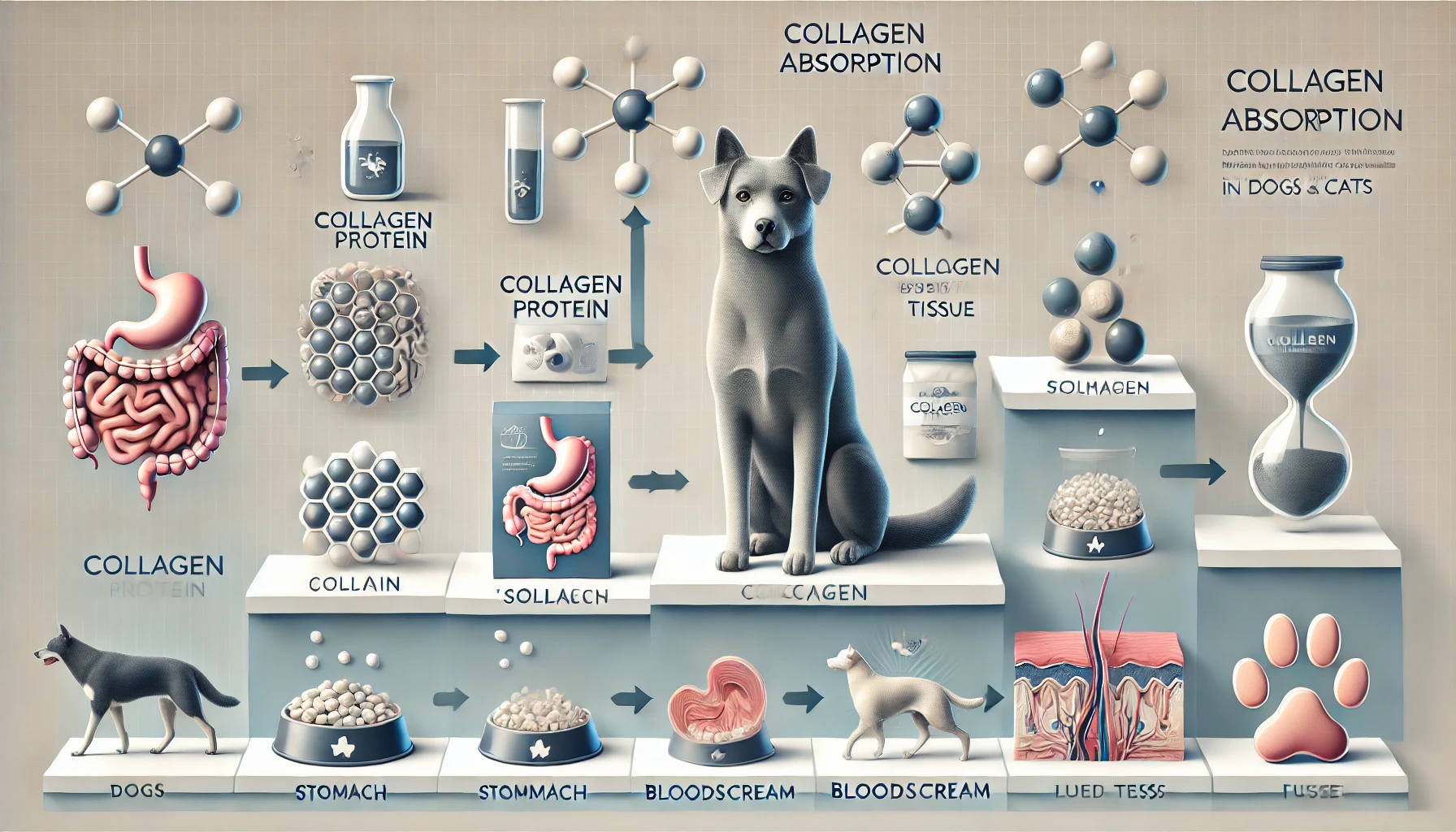
The supplement is made from natural ingredients containing collagen, such as freshly prepared meat and fish materials. These are easily digested and absorbed by animals, providing the building blocks (particularly the amino acids glycine and proline) needed for the body to produce more collagen, which helps maintain healthy bones, joints, and skin.
Studies have shown that peptides are more readily absorbed from the digestive tract than intact protein. To maximize the potential beneficial effects of dietary collagen, it is essential to ensure its optimal absorption.
STATEMENT
from
Prof. Dr. Krum Vladimirov Nedelkov, PhD
Faculty of Veterinary Medicine,
Trakia University, Stara Zagora
Regarding: the use of hydrolysed collagen in pet foods.
1. Information about proteins
A protein is a macromolecule consisting of about twenty different amino acids connected by peptide bonds. After being consumed by animals through the diet, proteins are hydrolysed to small peptides (di — and tripeptides) and free amino acids by enzymatic proteases and oligopeptidase in the small intestine (Wu, 2013). Enzymatic hydrolysis similar to that used in the production of pure amino acids for the pharmaceutical industry leads to the formation of stable protein sources composed exclusively of free amino acids and a small number of oligopeptides with very low molecular weight (Hou et al., 2013).
2. Results from the laboratory analysis
The laboratory testing of the hydrolysed animal collagen from pig skins of “Leather Art” Ltd. shows a high content of essential/indispensable amino acids such as Arginine (0.751 g/100g), Lysine (0.604 g/100g), Leucine (0.567 g/100g), Phenylalanine (0.342 g/100g), Threonine (0.319 g/100g) and others. Essential amino acids cannot be synthesised from other compounds, so they must be present in food. The hydrolysed collagen of “Leather Art” Ltd. would provide enough essential amino acids, whose synthetic analogues are extremely expensive and of far lower digestibility. In addition, the laboratory analysis of the hydrolysed collagen of “Leather Art” Ltd. shows an extremely high content of replaceable amino acids such as Glycine (2.29 g/100g), Proline (1.35 g/100g), HydroxyProline (0.945 g/100g) , Alanine (1.03 g/100g), Aspartic acid (0.863 g/100g) and others, which are in an easy and convenient form for absorption and assimilation by animals.
3. Use in pet foods
Diets with protein hydrolysates, and hydrolysed collagen in particular, became extremely popular in specialty clinical diets for pets as early as about 15 years ago. Diets containing hydrolysed collagen can significantly reduce adverse allergic reactions and reduce sensitivity to certain foods in dogs. Also, the use of hydrolysed collagen has a beneficial effect on some acute degenerative diseases in pets such as osteoarthritis. Imaging findings of the knee joint show that orally administered collagen peptides have great potential to stimulate proteoglycan synthesis in knee joints in mild forms of osteoarthritis (McAlindon et al., 2011). Previous research has shown that a reduction in lameness and increased mobility in dogs after treatment with collagen peptides is associated with significantly reduced plasma levels of MMP-3, which is involved in collagen degradation (Weide, 2004). Hydrolysed animal collagen also plays an important role in improving the palatability of pet foods. The hydrolysis process breaks down the proteins into smaller peptides that have the property of reducing bitterness and increasing the palatability and flavour of food. The improvement in the taste and aroma of the feed increases the animal’s desire for higher consumption, which leads to better nutrition and overall health. In addition, hydrolysed animal collagen can be tailored to specific dietary needs, ensuring that pets will receive optimal nutrition without compromising the taste or the texture of the food. This is particularly useful for dogs and cats with food sensitivities or allergies that require the preparation of specialised clinical/veterinary diets.
I recommend the use of the hydrolysed animal collagen of the company «Leather Art» Ltd. in maintenance foods for pets, as well as in special diets formulated to improve joint metabolism in osteoarthritis or other joint problems, especially after orthopaedic operations.
March 25, 2024 Signed by Prof. Dr. Krum Vladimirov Nedelkov, PhD
Stara Zagora